

“Great Wall With Gates” by Zhang Hongtu (2009), http://www.momao.com/
Together,
We Can Make a Difference
support us
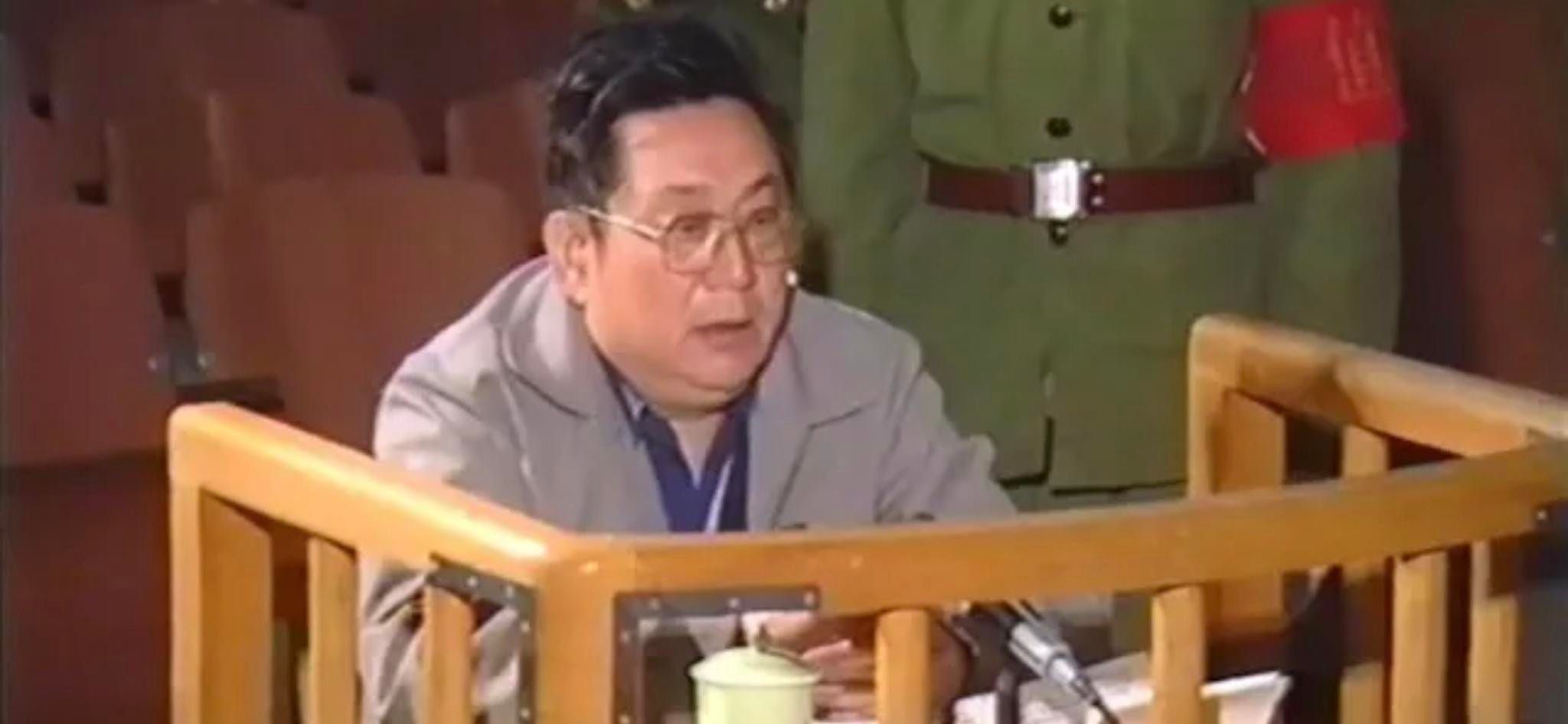
[Full Court Transcript] The Case of Xu Qinxian Resisting the Martial Law Order
December 05, 2025
[Full Court Transcript] The Case of Xu Qinxian Resisting the Martial Law Order
Date: 1990
Location: Military Court of the Beijing Military Region
Defendant: Xu Qinxian (Former Commander of the 38th Group Army, Major General)
[Start of Trial and Identity Verification]
Presiding Judge: The Court Clerk, Public Prosecutor, and Defense Counsel have entered the courtroom. The defendant has been escorted to the waiting area. Preparations for the hearing are complete.
Presiding Judge: The Military Court of the Chinese People's Liberation Army Beijing Military Region is now in session. Bring the defendant, Xu Qinxian, to the court.
(Xu Qinxian enters and sits down)
Presiding Judge: Defendant Xu Qinxian, do you have any other names?
Xu Qinxian: No.
Presiding Judge: How old are you this year?
Xu Qinxian: 55 years old.
Presiding Judge: In which year were you born?
Xu Qinxian: August 1935.
Presiding Judge: Ethnicity?
Xu Qinxian: Han.
Presiding Judge: Where is your ancestral home?
Xu Qinxian: Laiye, Shandong (Note: Likely Ye County/Yexian, Shandong or Dawu); I was born in Shandong.
Presiding Judge: Where is your current residence?
Xu Qinxian: Badachu, Beijing... (Specific address unclear).
Presiding Judge: What is your education level?
Xu Qinxian: Junior College (Associate degree equivalent).
Presiding Judge: When did you enlist?
Xu Qinxian: December 1950.
Presiding Judge: What positions have you held since enlisting?
Xu Qinxian: Cadet, Staff Officer, Company Commander, Battalion Commander, Regimental Chief of Staff, Division Chief of Section, Division Chief of Staff, Division Commander, Deputy Corps Commander.
Presiding Judge: When were you appointed Commander of the 38th Group Army?
Xu Qinxian: December 1987.
Presiding Judge: When were you awarded the rank of Major General?
Xu Qinxian: September 1988.
Presiding Judge: When were you placed under residential surveillance?
Xu Qinxian: September 11, 1989.
Presiding Judge: At what location?
Xu Qinxian: Beijing Garrison Command... (Location unclear).
Presiding Judge: For what crime were you arrested in accordance with the law?
Xu Qinxian: On January 9, 1990. The arrest warrant stated "for disobeying martial law orders."
Presiding Judge: Where have you been held since your arrest?
Xu Qinxian: The Detention Center of the Beijing Military Region.
Presiding Judge: Have you received any awards in the past?
Xu Qinxian: I have earned merits, served as an advanced worker, and received some awards; I can't remember them all clearly.
Presiding Judge: Have you ever received disciplinary action?
Xu Qinxian: I don't remember this clearly. I was certainly criticized because I once lost a map. I don't know if it ended with a disciplinary sanction or just a criticism.
Presiding Judge: Defendant Xu Qinxian, sit down. I now announce to you the members of the Collegiate Bench... (Reading of the list and defendant's rights). Do you apply for recusal (request any member to withdraw)?
Xu Qinxian: I do not apply.
[Court Investigation: Reading of the Indictment]
Public Prosecutor: Indictment of the Military Procuratorate of the Chinese People's Liberation Army Beijing Military Region, (90) Jing Jun Jian Zi No. 1.
Defendant Xu Qinxian, Male, Han ethnicity, 54 years old... (Resume omitted).
Investigation has ascertained: At approximately 16:00 on May 18, 1989, Liu Zhenhua, Political Commissar of the Beijing Military Region, and other leaders conveyed the order from the Central Military Commission (CMC) regarding the deployment of the 38th Group Army to Beijing to execute martial law tasks to Xu Qinxian at the Military Region office building. Xu Qinxian immediately refused to lead the troops into Beijing to execute the martial law mission.
He stated: "For a major event like deploying troops, I suggest that the Standing Committee of the National People's Congress and the plenary session of the State Council discuss it. Is doing this right or wrong? Such an order should be issued by the State; it is inappropriate to issue it in the name of the Party."
He further stated: "Such an action must stand the test of history. It may not be clear in the short term, but history will prove it. Executing such a task might lead to merit, but it could also make one a sinner of history."
He claimed: "Regardless of the weapons (equipment), I cannot execute such a task. The Central Military Commission can appoint me as Commander, and it can also remove me from my post. I cannot execute such an order; please ask the leadership to find someone else."
Under the severe criticism and orders of the Military Region leadership, Xu went to the Military Region Operations Duty Room and used a secure telephone line to convey the CMC order to Wang Fuyi, the Political Commissar of the Group Army. He told Wang: “I do not agree with this method. I cannot execute this order. I cannot command. As for who will command, you decide.”
That evening, Xu Qinxian called Political Commissar Liu of the Military Region and said: "I have passed down the order. Do not look for me regarding this matter from now on."
Public Prosecutor: Defendant Xu Qinxian, as a Corps Commander, at a critical moment involving the life and death of the Party and the State, openly disobeyed orders, seriously harming the interests of the Party and the State. The nature of the act is vile, and the consequences are serious. According to the "Criminal Law of the People's Republic of China" and Article 17 of the "Provisional Regulations on Punishing Servicemen for Transgression of Duties," his actions constitute the crime of "disobeying martial law orders." Public prosecution is hereby instituted.
[Court Investigation: Interrogation of the Defendant]
Presiding Judge: Defendant Xu Qinxian, we will now investigate the facts of your crime regarding the resistance to the martial law order. When, where, and from whom did you receive the notification to go to the Beijing Military Region Headquarters to receive the assignment?
Xu Qinxian: At noon on May 18, 1989, I received a call from Deputy Chief of Staff Tang Minghong at the Army Headquarters, telling me to go to the Military Region to receive an assignment.
Presiding Judge: How did Tang Minghong notify you?
Xu Qinxian: By telephone.
Presiding Judge: What did you say to Tang Minghong?
Xu Qinxian: At the time, I was hospitalized due to illness (kidney stones). He asked if I could go. I said the stone had been passed yesterday, so I could barely manage to go.
Presiding Judge: When did you fall ill and enter the General Hospital of the Beijing Military Region?
Xu Qinxian: Around noon on May 16, 1989.
Presiding Judge: When was the stone passed?
Xu Qinxian: Around dinnertime on May 17.
Presiding Judge: What was your physical condition after passing it?
Xu Qinxian: Weak, in pain, and lacking strength. Because the attack in May had tormented me for two or three days.
Presiding Judge: What time did you arrive at the Beijing Military Region Headquarters?
Xu Qinxian: Around 16:00.
Presiding Judge: Where was the assignment received?
Xu Qinxian: The conference room on the west side of the third floor of the main building of the Military Region.
Presiding Judge: Which chiefs and staff members attended?
Xu Qinxian: Political Commissar Liu Zhenhua, Deputy Commander Li Laizhu, Commander Zhou Yibing (Note: Xu misspoke; likely Zhou Yushu or Zhou Yibing was not present, later testimony corrects this), the Director of the Operations Department, and Deputy Chief of Staff Huang Yunqiao, among others.
Presiding Judge: Which chief gave you the assignment?
Xu Qinxian: Mainly three chiefs spoke. Commissar Liu explained the situation, saying there were some demonstrations in Beijing and the situation was somewhat serious. Deputy Commander Li mainly spoke about the specific martial law tasks, which units would send how many people, and what weapons and equipment.
Presiding Judge: What was the specific task?
Xu Qinxian: Several points were designated to be entered first to execute martial law duties.
Presiding Judge: Who was ordered to execute the martial law task?
Xu Qinxian: For our Army, it was 15,000 personnel, 200 to 300 armored vehicles, carrying weapons and ammunition.
Presiding Judge: When were you required to arrive in Beijing?
Xu Qinxian: May 20.
Presiding Judge: Specifically what time?
Xu Qinxian: I can't remember clearly, but it was the 20th.
Presiding Judge: What did Political Commissar Liu Zhenhua say at the time?
Xu Qinxian: The general meaning was that Vice Chairman Yang Shangkun had called a meeting of leading comrades, saying the situation in Beijing was developing; if we retreat a bit, they advance a bit, and some pamphlets about Hu Yaobang had appeared, etc.
Presiding Judge: The transfer of the 38th Group Army to Beijing to execute martial law duties—whose order was that?
Xu Qinxian: My impression is that it was an order from the CMC Headquarters.
Presiding Judge: The decision to impose martial law on parts of Beijing—where was that decision made?
Xu Qinxian: Now, of course, I know; it was the Party Central Committee, the State Council, and the Central Military Commission.
Presiding Judge: After the Military Region chiefs issued the order, as the Commander, how did you express yourself at that time?
Xu Qinxian: After the chiefs finished speaking, I first asked about some unclear issues. For example, regarding weapons and equipment, I asked what "other weapons" included. The chief answered: heavy machine guns. I also asked if the number of armored vehicles was sufficient. After asking these questions, I spoke. I said: I have a different opinion on this matter. I said this is a mass political movement and should primarily be solved through political means. If force must be used, the Armed Police and Public Security should be enough. If the Field Army must be used, I suggest moving the Field Army to the suburbs of Beijing to maintain deterrence and facilitate maneuvering.
Xu Qinxian: I said such a major event should be studied very well. I suggested that the Politburo, the State Council, and the Central Military Commission hold a meeting to discuss it properly... I also said that since the military is integrated into the state system, the National People's Congress could also discuss it.
Presiding Judge: Did you say, "Executing such a task might make one a sinner of history"?
Xu Qinxian: I did say that at the time.
Presiding Judge: Did you say, "I cannot execute such a task carrying weapons"?
Xu Qinxian: I said this task is different from combat or disaster relief. In combat missions, the battle lines are clear. In this task, good people and bad people are mixed together, the army and the common people are mixed together—how can this be executed?
Presiding Judge: Did you say, "The Central Military Commission can appoint me as Commander, and it can also remove me from my post"?
Xu Qinxian: The chief said, "You should still convey [the order]; it's not good if it doesn't go through you, the Commander." I said: "Superiors can appoint me, and they can also dismiss me."
Presiding Judge: Did you say, "Please ask the leadership to find someone else"?
Xu Qinxian: I don't remember that phrase clearly.
Presiding Judge: regarding the execution of the CMC order, what exactly was your attitude? Was it that you had serious reservations, or was it a resolute refusal to execute?
Xu Qinxian: My personal thought at the time was: As a unit, it should resolutely execute [the order]; as an individual, I was unwilling to participate.
Presiding Judge: You are a high-ranking commander, not an ordinary soldier. Can you participate if you want and not participate if you don't? What does this imply?
Xu Qinxian: It implies that I personally would not execute the order.
[Court Investigation: Presentation of Witness Testimony]
(The Public Prosecutor reads the testimony of Tang Minghong, Deputy Chief of Staff of the 38th Army, confirming Xu Qinxian's physical condition allowed him to attend the meeting.)
(The Public Prosecutor reads the testimony of Xu Qinxian's guard, Jia Yucong, and the document clearance registry, confirming that the meeting minutes were in Xu's briefcase.)
(The Public Prosecutor reads Xu Qinxian's handwritten notes: These recorded the key points of speeches by Yang Shangkun, Liu Zhenhua, Li Laizhu, etc., including details like "defining the nature as turmoil," "the April 26 Editorial," "deploying 50,000 troops," and "carrying weapons." Xu Qinxian confirms he wrote this personally.)
(The Public Prosecutor reads the testimony of Beijing Military Region Political Commissar Liu Zhenhua)
Liu Zhenhua's Testimony: On the afternoon of May 18, I conveyed the order at the Military Region. Xu Qinxian said: "I have an opinion... A major event like moving the army should be discussed by the Standing Committee of the National People's Congress... Such an order should be issued by the State; it is inappropriate to issue it in the name of the Party... I cannot execute such a task carrying weapons. You can replace me. The Central Military Commission can appoint me as Commander, and it can also remove me from my post." I subjected Xu Qinxian to severe criticism and education, requiring that he must convey the order.
Presiding Judge: Defendant, do you have any comments on Commissar Liu's testimony?
Xu Qinxian: Regarding the statement in the testimony "It is inappropriate to issue orders in the name of the Party," I did not say that. What I said was a suggestion that the Politburo, the State Council, and the CMC discuss it. As for the issue of "State issuance," that concept was not in my mind.
(The Public Prosecutor reads the testimony of Beijing Military Region Deputy Commander Li Laizhu, similar in content to Liu Zhenhua, confirming Xu Qinxian's insubordination.)
(The Public Prosecutor reads the testimony of Beijing Military Region Chief of Staff Zhou Yushu)
Zhou Yushu's Testimony: Xu Qinxian said, "Good people and bad people are mixed together, how to execute? ... One might become a hero, or one might become a sinner of history." Commissar Liu criticized him, and subsequently, I took him to the Operations Department to call Political Commissar Wang Fuyi of the 38th Army.
(The Public Prosecutor reads the testimony of 38th Army Political Commissar Wang Fuyi)
Wang Fuyi's Testimony: After 5:00 PM on May 18, Xu Qinxian called me to convey the order. After conveying it, he said: "I do not agree with this method. I cannot execute this order. I cannot command. As for who will command, you decide." That night, the Military Region asked me to work on Xu, but he still expressed he would not participate.
Presiding Judge: Defendant, do you have any comments on Wang Fuyi's testimony?
Xu Qinxian: Most of the meaning is correct. But I didn't say "You find someone else"; I said, "You all study how to execute it; I have a different opinion."
(The Public Prosecutor reads the testimony of 38th Army Deputy Political Commissar Wu Yunzhong, confirming he went to the hospital to persuade Xu Qinxian, but Xu still insisted on not participating personally.)
[Court Investigation: Evidence Regarding Consequences]
Public Prosecutor: Defendant Xu Qinxian's act of resisting the martial law order caused vile political influence both domestically and internationally.
(The Public Prosecutor reads reports from foreign wire services and newspapers: AP, Reuters, Taiwan's "Central Daily News," etc., reporting news such as "38th Army Commander Refuses Orders" and "38th Army Commander Resigns." Reads leaflets found in Tiananmen Square calling Xu a "Hero of Democracy.")
Presiding Judge: Defendant, what is your opinion on these foreign reports and leaflets?
Xu Qinxian: Due to my own issues, opportunity was provided to turmoil elements and hostile foreign forces to spread rumors and slander. I acknowledge this consequence.
[Court Debate]
Public Prosecutor's Statement:
Defendant Xu Qinxian, as a senior ranking general, disobeyed CMC orders at a critical moment, damaging the interests of the Party and the State.
His actions seriously interfered with military deployment and caused serious political consequences.
His actions objectively fueled the arrogance of the turmoil elements and increased the difficulties for the troops executing martial law tasks.
He was utilized by the enemy, causing a vile international impact.
Xu Qinxian, as a soldier, opposing orders with "personal opinions" is not just an ideological problem but a serious criminal act. Although he has historical achievements, merit cannot offset faults. We suggest severe punishment according to the law.
Defendant Xu Qinxian's Self-Defense:
Regarding "Analogy" in Sentencing: The Public Prosecutor is using the crime of "disobeying orders in wartime" by analogy to determine guilt. I think this is somewhat forced. The martial law task is different from fighting a war. In war, the battle lines are clear; this time, common people and the army were mixed together. The nature is very different.
Regarding Discrepancies in Testimony: Many witness testimonies were added later, and I did not say some of those things. For example, "It is inappropriate to issue in the name of the Party"—I did not say that.
Regarding Motive: I indeed had mental reservations at the time. I believed that the Central Committee's previous handling methods (such as dialogue) were effective. Suddenly shifting to the use of force, and specifically fully armed field armies, I worried that a large-scale bloody conflict would occur. I hoped for a proper resolution so that a bloody incident would not happen. If my suggestion was wrong, or the setting was wrong, that is a matter of understanding. But to treat it entirely as a "crime," I think is not entirely appropriate.
Although I had mental reservations, I still conveyed the order to the Political Commissar of the 38th Army and did not obstruct the unit's actions. It was only me personally, in that conflicted and painful state of mind, who expressed "I am unwilling to participate."
Regarding Consequences: Many of the rumors from the outside world were fabricated by others; not all accounts can be settled on my head.
Defense Attorney's Statement:
Although the nature of Xu Qinxian's behavior is serious, considering:
His behavior belongs to "passive non-execution," which is different from "obstructing troops from executing" or "inciting rebellion." He did convey the order.
He expressed to the organization later that he was "willing to participate" (though it did not happen), showing signs of repentance.
He has enlisted for 40 years and has outstanding war merits.
We earnestly request the court to give comprehensive consideration during sentencing.
Public Prosecutor's Rebuttal:
The so-called "conveying of the order" by the defendant was done under the severe criticism of the chiefs and under duress. He personally explicitly stated "I will not execute, I will not participate"—this is insubordination. As a Corps Commander, not commanding is dereliction of duty and insubordination. A so-called "good motive" cannot cover up the fact of insubordination.
Xu Qinxian's Final Statement:
Is it a mistake or a crime? Is it an ideological problem or a political problem? I believe the court will make a judgment based on the facts. I have nothing more to say.
(End of Court Debate)